I’ve spent a lot of my career working on digital products, trying to make things easier for customers. Removing unnecessary steps, simplifying experiences and figuring out why seemingly straightforward things often end up being so complicated.
Then I’d go travelling and find myself dealing with exactly the sort of experience that frustrates me.
Getting mobile data working overseas.
It shouldn’t be difficult. Most of us carry fairly sophisticated smartphones around in our pockets, and mobile networks exist pretty much everywhere we’re likely to travel. Yet somehow, getting connected when you land in another country can still involve expensive roaming charges, buying a local SIM card or signing up to another service with its own app and account.
I’ve used plenty of travel eSIMs over the years. Some have been excellent. Others have left me wondering why something as simple as buying mobile data needs quite so many steps.
Eventually, I started wondering how difficult it would be to build something myself.
That question turned into SimKit.
It’s a small side project I’ve been building outside my day job. I wanted to see whether I could take something I regularly found frustrating and create a simpler, more affordable alternative.
It’s been an interesting experience, particularly now that real people are using something I’ve built.
The problem that got me started
Living in Australia, international travel can be expensive enough without worrying about what your phone is going to cost once you arrive.
Take international roaming.
At the time of writing, Telstra charges $10 a day for its International Day Pass across more than 80 destinations, including Indonesia, Japan, the UK and much of Europe. That includes 2GB of data and standard calls and texts.
A week away using the service every day costs $70.
And the daily charge isn’t necessarily triggered by doing anything particularly exciting. Sending a text, answering a phone call or having an app use data in the background can be enough.
Optus has a $5 daily roaming option with 5GB of data on eligible plans, while other plans have a $10 roaming pass. Vodafone also offers $5 roaming on eligible plans.
To be fair, some of these are decent options. Depending on your destination, your existing plan and how much data you use, roaming can make more sense than buying a separate travel eSIM.
My frustration was more with the fact that we were still dealing with daily roaming fees in the first place, when buying a fixed amount of data from a network overseas should be relatively straightforward.
And while travel eSIM providers have made things significantly easier, I found that some had introduced a different kind of complexity.
Another app to download. Another account to create. Another verification email. Another interface to work out when all you really want is internet access.
I understand why companies build these experiences. I’ve spent enough time working with digital channels and loyalty to appreciate the value of an app, a registered customer and an ongoing relationship.
But I kept coming back to a simple question.
Does someone buying mobile data for a holiday actually need any of that?
I didn’t think so.
How difficult could it be to build something better?
This is where things got interesting.
A few years ago, building a business that sells mobile connectivity across multiple countries would have been a fairly significant undertaking.
You’d need relationships with telecommunications providers, payment infrastructure, technical resources and systems to provision services across different networks.
A lot of that infrastructure is now available through APIs and specialist providers.
You don’t need to build a mobile network to sell an eSIM. You need to integrate with businesses that already provide that connectivity, then build a customer experience around it.
The same applies to payments, hosting and much of the technology that sits behind an online business.
For SimKit, payments are handled through Stripe, infrastructure runs on services from AWS and Google, and the actual eSIM connectivity comes from established telecommunications networks.
That gave me the opportunity to focus on the part I was most interested in: making the buying experience easier.
I wasn’t trying to invent a new telecommunications technology.
I wanted to see whether I could build a better way of accessing something that already exists.
That’s an important distinction, and I think it’s one of the more interesting opportunities for people building digital products today.
You don’t necessarily need a completely original idea. Sometimes the opportunity is to take an existing service and make it noticeably easier to use.
What I wanted SimKit to be
I started with a fairly simple idea.
Someone should be able to visit a website, choose where they’re travelling, select how much data they need, pay and have an eSIM ready to install.
Ideally, the whole process should take a couple of minutes.
No additional app to download. No physical SIM card. No wandering around an airport trying to find a mobile phone shop.
That became the foundation of SimKit.
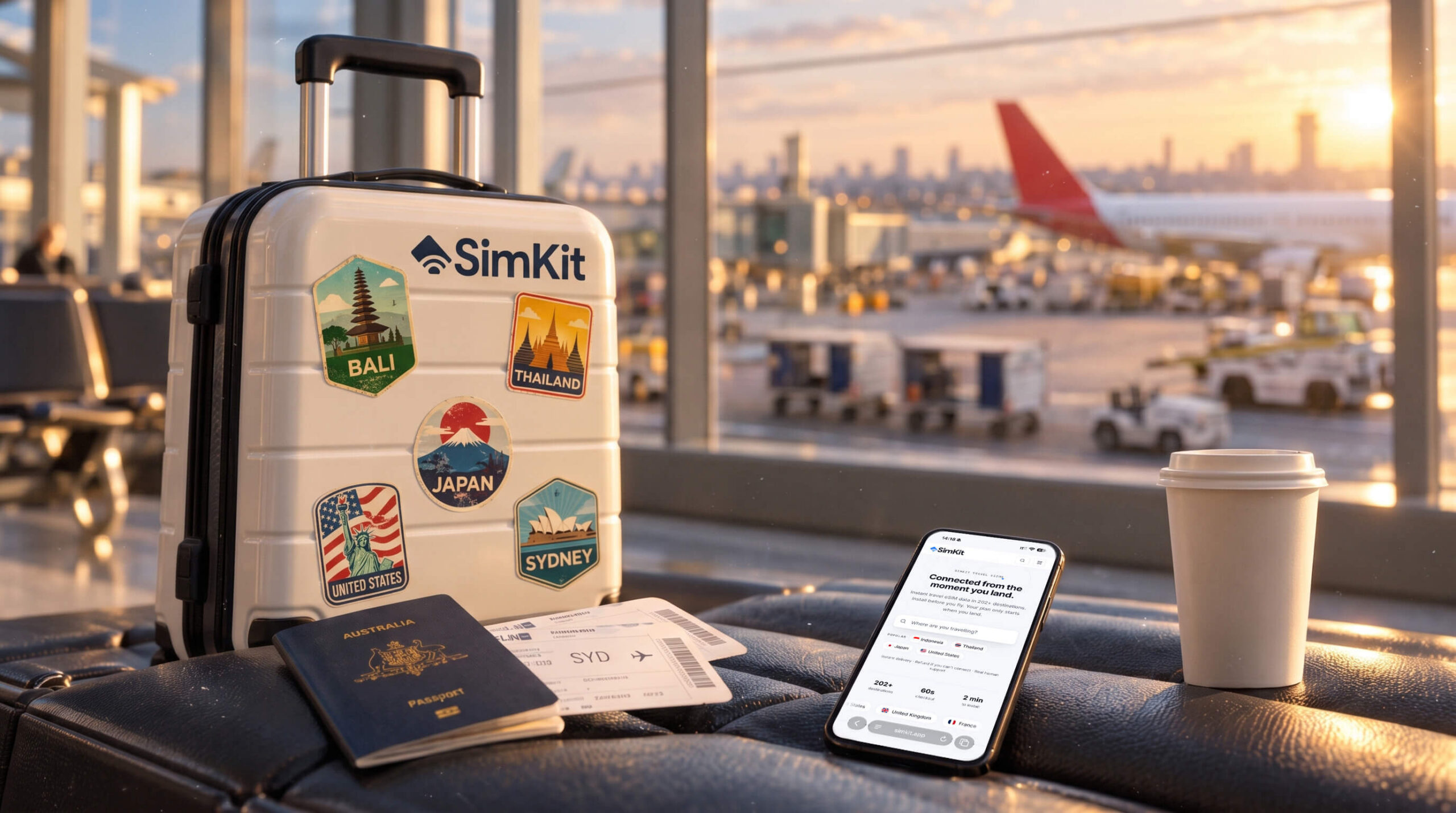
Today, it offers prepaid travel eSIMs for more than 200 destinations, including popular places such as Bali, Thailand, Japan, the United States and Europe.
You choose a destination and data plan, pay online and receive the eSIM immediately.
On compatible devices, you can install it directly from your phone. There’s also a QR code option if you’d prefer to install it that way.
One thing I was particularly keen on was allowing people to get everything sorted before they travel.
With SimKit, the plan’s validity period begins when the eSIM first connects to a supported network at the destination. You can install it at home, while you’ve got a reliable Wi-Fi connection, rather than trying to work things out after a long flight.
Your regular SIM stays in your phone, so you can keep your Australian number and use the travel eSIM for mobile data. Calls or other usage on your home line can still attract your carrier’s roaming charges, so it’s worth checking those settings before leaving.
You can also check your data and top up supported plans through the website.
None of these features is particularly revolutionary.
In fact, that’s largely the point.
I didn’t want to build an enormous travel platform with a hundred different features.
I just wanted buying mobile data to be one less thing people needed to think about before a trip.
Building the product was only part of the challenge
One thing I’ve been reminded of while building SimKit is that getting a product working and getting people to use it are two very different things.
When you’re building something yourself, it’s easy to spend hours refining details that probably don’t matter nearly as much to the customer as you think they do.
You become obsessed with page layouts, button placement, loading speeds, checkout flows and all the little things that make a digital experience feel polished.
Then you launch it and realise that nobody knows it exists.
Suddenly, the problem changes.
How do you get people to discover it? How do you convince them to trust it? And how do you turn someone browsing your website into someone who actually makes a purchase?
I’ve been experimenting with Google Ads, social media and different approaches to reaching people who are preparing to travel.
It’s been a useful reminder that building the technology is only one part of creating a business.
You can have a working product, competitive pricing and a website you’re happy with, but none of that automatically means someone is going to buy from you.
Especially when you’re competing against established brands that customers already recognise.
That’s something I’m still figuring out.
The part you don’t think about until real customers arrive
There’s another side to running an eSIM business that becomes very real when people start buying your product.
Customer support.
When someone buys a travel eSIM, they’re trusting you with something fairly important.
They might need it to find their hotel, book transport, contact family or simply work out where they’re going after landing in a country they’ve never visited before.
If it doesn’t connect, they’re not thinking about your product roadmap or how nicely you’ve designed the checkout.
They just need it to work.
I’ve had customers get in touch because an eSIM wasn’t activating properly or because they couldn’t establish a connection.
Sometimes it’s a device setting. Sometimes the issue sits further down the chain with provisioning or network connectivity.
And occasionally the right answer is to issue a replacement or refund the customer.
I’ve also tested plans myself while travelling, including in Thailand, to understand how the experience works outside the comfort of a development environment.
It’s one thing seeing a successful transaction and an eSIM issued correctly on a dashboard.
It’s another thing knowing someone can actually use it when they arrive overseas.
These experiences have probably taught me more about what the product needs than any amount of time spent looking at the website.
They’ve also reinforced something I believe about digital products generally.
A good customer experience isn’t just what happens when everything works. It’s what happens when something goes wrong.
For SimKit, that means making installation instructions easier to follow, helping people understand their device settings and being available when someone needs assistance.
It’s a small business, and that gives me the advantage of being close to those problems.
The person making decisions about what to improve is also the person seeing the customer feedback.
I like that.
Getting people to trust something you’ve built
One of the challenges I underestimated was just how much trust matters when you’re launching a product nobody has heard of.
Think about how you buy things online.
If you’re purchasing from Amazon, Apple or another established brand, you probably don’t spend much time wondering whether the transaction is legitimate.
You already know the name. You’ve likely used the service before. You assume it’ll work.
Now imagine you’ve just discovered an unfamiliar eSIM website through Google.
You might like the price. The website might look good. The product might have exactly the data allowance you need.
But you’ve still got to decide whether you trust it.
That’s a completely reasonable hesitation, especially when you’re buying something you’ll depend on in another country.
It has made me think more carefully about how SimKit communicates the things that matter.
Who’s behind the business? How do payments work? What happens if the eSIM doesn’t connect? Can customers actually get help?
SimKit is an Australian-owned business based in Sydney. Payments are processed securely through Stripe, and customers can contact support if something goes wrong.
If we can’t resolve a connectivity issue that’s our responsibility, we’ll arrange a replacement or refund in line with our terms.
These aren’t particularly exciting selling points, but I think they’re important.
And when a customer gets in touch to say their eSIM worked perfectly throughout a trip, it’s genuinely satisfying.
I think that’s one of the things I enjoy most about building something myself.
You get to see the direct relationship between a decision you’ve made and somebody else’s experience.
There’s no large organisation or complicated reporting structure between the two.
Someone uses what you’ve built, and you find out whether it was actually any good.
What SimKit has taught me about building products
I’m still early in the journey with SimKit, and I certainly wouldn’t pretend to have everything worked out.
There’s plenty to improve, particularly around reaching new customers and making the overall experience even simpler.
But the process has reinforced a few things for me.
The first is how accessible building digital products has become.
Between APIs, cloud infrastructure, modern development tools and AI, an individual can now attempt projects that would previously have required a sizeable team and significant investment.
That doesn’t mean building a successful business is easy.
The technology might be more accessible, but you still need to understand the problem, make sensible product decisions, acquire customers and support whatever you’ve created.
The second is how easy it is to overcomplicate a product.
When you have access to all these tools, there’s a temptation to keep adding features simply because you can.
I’ve tried to resist that with SimKit.
I don’t think it needs a complicated loyalty programme, a social community or an app that asks people to keep coming back every day.
Most customers will probably buy a plan, use it for their trip and forget about SimKit until the next time they travel.
I’m perfectly happy with that.
The third is that you learn a lot more by putting something in front of real customers than by endlessly refining an idea.
It’s quite easy to convince yourself that something makes sense when you’re the only person using it.
Real customers have a habit of showing you things you hadn’t considered.
They use different phones, follow instructions differently, travel to places you haven’t tested and run into problems you didn’t anticipate.
And every one of those interactions gives you an opportunity to make the product better.
Why I think more people should build things
I don’t think everyone needs to launch a startup.
And I certainly don’t think every personal project needs to become a business worth millions of dollars.
But I do think more people should have a go at building something that interests them.
Particularly now.
There’s an enormous difference between reading about what technology can do and actually trying to make something useful with it.
You learn about the limitations, the trade-offs, the annoying little things that don’t work and the decisions you wouldn’t necessarily appreciate from the outside.
For me, SimKit has been a way to explore all of that while solving a problem I’ve personally experienced.
It’s also been a nice opportunity to work on something where I can make a decision, implement it, test it and see what happens without needing to turn it into a major project.
That freedom is enjoyable.
Not every experiment works, and not every idea deserves to become something bigger.
But you usually come away knowing more than you did when you started.
So, what’s next for SimKit?
For now, I want to keep improving it.
Making it easier to discover, easier to buy and even easier to get connected.
There’s a lot more I can do around the installation experience, customer support and helping travellers choose the right plan without having to understand all the technical details behind an eSIM.
I also want to keep testing the product myself whenever I travel.
There’s something useful about being both the person building the experience and the person relying on it.
I don’t know how big SimKit will become, and I’m not particularly worried about that at this stage.
It’s a personal project, something I’ve enjoyed building, and an opportunity to keep learning.
If it saves someone money on roaming and gets them connected without the usual hassle, then it’s doing what I set out to achieve.
And if you’ve ever found yourself frustrated by something that really shouldn’t be as complicated as it is, maybe it’s worth having a go at fixing it yourself.
You might be surprised by what you can build.
If you’re curious about SimKit, you can check it out at SimKit.app.
I’ve also set up a little thank-you for anyone who’s made it this far. Use the code BLOG for 15% off your travel eSIM.
And if you do give it a try, I’d genuinely love to hear what you think. Especially if there’s something I could make better.
A few questions about travel eSIMs
What is a travel eSIM?
A travel eSIM is a digital SIM that lets you purchase mobile data for another country without using a physical SIM card. You install it on an eSIM-compatible, network-unlocked phone and connect to supported mobile networks at your destination.
Is a travel eSIM cheaper than international roaming?
Often, but not always. For example, Telstra’s $10 International Day Pass would cost $70 for seven days of use, while some prepaid travel eSIMs can provide a suitable data allowance for less. However, eligible Optus and Vodafone customers may find their $5 roaming options competitive, particularly if they need calls and texts as well as data.
Do I need to download an app to use SimKit?
No additional app is required. You can buy and manage a SimKit eSIM through your browser. Compatible devices support direct installation, while QR code and manual installation options are also available.
Can I keep my Australian phone number while using SimKit?
Yes, on a compatible dual-SIM phone. SimKit provides mobile data while your regular SIM can remain available for your Australian number. Receiving SMS messages is generally free on the major Australian carriers, but calls, outgoing texts and other usage may trigger roaming charges.
When should I install a travel eSIM?
Ideally before leaving home, while connected to reliable Wi-Fi. SimKit plans start their validity period when they first connect to a supported network at the destination, so you can prepare your phone before travelling.